

There’s a lot to look forward to as a rising senior in high school. Graduation, college, and much more are coming up, and while excitement surrounds senior year, this time also brings up a healthy amount of stress, apprehension, and fear.
The dreaded college applications that come before most of these celebrations have been on most high schoolers’ minds since freshman year, and there comes a time for everyone to tackle them. The worst part? Submitting test scores.
Standardized tests are different for everyone, but the ACT and SAT hold an important place in every student’s college application, meaning that months of work, tutoring, and repeated testing often characterize much of someone’s junior and senior years.
Feelings surrounding the tests vary drastically from student to student, with some appreciating the process and others dreading anything related to testing.
Eric Fine, a junior at HBHA, has had a better experience, saying, “Personally, I’ve benefited a lot from standardized testing, as I’m generally a good test taker, and it has given me… the opportunity to go down the track of National Merit Scholar.”
Many benefits can arise from standardized testing, from simply highlighting your test-taking skills to huge benefits for your college search/application process, like the National Merit Scholar opportunity.
While some appreciate the process, it is a long and draining experience for many others.
Dani Glickman, a junior at HBHA, says, “I really don’t like it. I don’t enjoy the experience taking it, and I don’t enjoy the experience preparing for it.”

The act of preparing for these tests may seem simple, but it can often be even more strenuous than taking the tests themselves. For students looking to apply to competitive schools, the pressure of doing well on the test of their choice can take a huge mental toll on them.
This mental toll, especially during the test itself, can be even harder for those with a 504 plan.
While feelings tend to differ on standardized tests, the complications that arise from each college’s different rules surrounding them are always similar.
In 2020, when rising college freshmen were in the throes of the pandemic and online school, colleges changed requirements to make standardized tests optional.
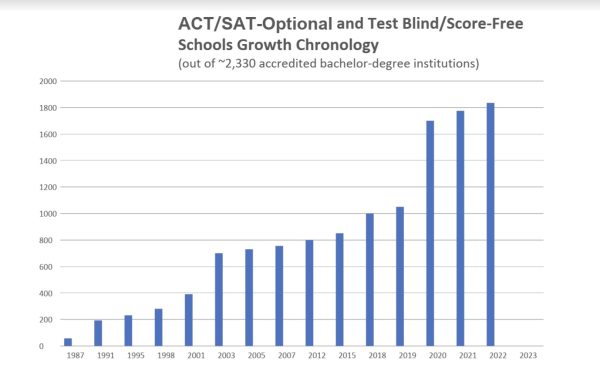
This switch led to an easier college admissions experience for many students struggling to stay on top of their studying at home, and as their abilities to actually take the tests were impeded, space for them to still be considered by colleges was expanded.
The switch to optional testing led to a large array of conversations throughout the U.S. on whether standardized tests were a legitimate way of gauging someone’s academic performance. “Standardized tests don’t accurately measure student learning and growth,” says Cindy Long from the National Education Association.
However, time has shown again and again that academic performances on standardized tests actually do correlate to greater academic performance at universities. “No, standardized tests are not perfect, but…they’re certainly worth preserving, particularly as we’re still working to track and reverse the Covid-19 pandemic’s lingering disruptions on student learning,” states Victoria McDougald from the Thomas B. Fordham Institute.
A competitive school like Harvard would prefer a 36 ACT score to a 20. But in the end, what matters more: your test score or the other aspects of your application?
Kristin Huston, the English teacher and College Guidance Counselor at HBHA, commented on this balance, saying, “Yes, the tests are a thing. We have to take them, and they can be important, but they’re not as important as the other metrics…So they’re not as important as…your extracurriculars and your essay.”
The debate surrounding standardized testing and the benefits of each test is constantly evolving, and each college applicant will eventually have to choose their own adventure, whether that is the SAT, the ACT, or neither.