

When HBHA students begin their athletic careers, many are faced with the tough decision of whether to play for their school or to play for a club team. There are several pros and cons to both options, and for many, with the opportunity to play club, it seems hard to pass up.
HBHA has no-cut sports. This provides HBHA students with opportunities that they would not receive at a club or public school.
This is great for HBHA, but with walk-on teams, come drawbacks. Sam Matsil, HBHA alumni and Athletic Director, said, “We struggle with a lack of commitment because you don’t have to try out. That’s also part of the charm in that everybody gets to participate if you want to.”
Four-sport HBHA athlete, David Wasserman, said that students who participate in HBHA sports are “definitely representing the Jewish group of Kansas City.”
Club sports provide athletes with opportunities to advance to a higher level.
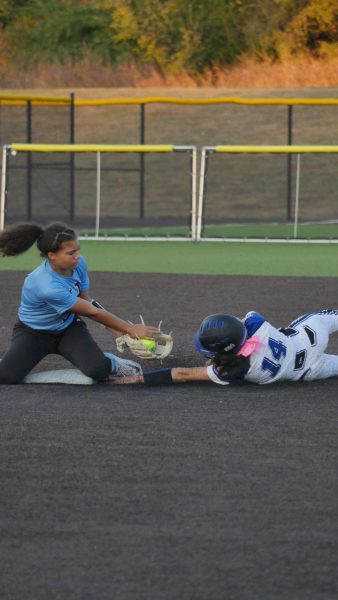
Sabra Bergh, a junior at HBHA, played six years of club softball and is currently a member of the HBHA varsity girls basketball team and HBHA varsity girls volleyball team.
Bergh shared her thoughts on how playing club sports positively affected her in a way HBHA sports have not affected her. Bergh said, “I think it also does make a person more well-rounded. I learned so much more discipline and so much more.” Specifically, Bergh described how club practices and HBHA practices compare. “When you run in basketball practice, other people are complaining about it, and you’re like, this is not bad.”
A lot of people might just think that the intensity of practices is because clubs pay their coaches, and the majority of coaches for HBHA are volunteers.
But this is not the case; the differences are not due to the coach’s background or previous experiences, but because of the pressure and motivation within club sports to be the best. Once Bergh started playing high school sports, her coaches at softball and HBHA sports were “kind of at the same level.”
A huge benefit for Bergh when playing on a club team is the added social opportunities.
Bergh said, “I was able to meet a lot of people outside of school, which was really nice just to have that separate friend group.”
Along with a different social circle, “I didn’t have the pressure to do amazing things in school to play the sport.” She also expressed the benefit of how “club sports don’t care what your grades are.” Bergh said.
When playing for HBHA, you are playing on a team with the same people you go to school with. “Because all of your friends in school are also on the team, if there’s drama, or if there’s something bad that happened at school that day, you can definitely carry that on at practice or games. Or if you don’t love someone on the team and they’re on your team at school, it translates to games,” Bergh said.
Wasserman said, “Those are the people that you’ve seen every day, and so you’re kind of more comfortable being with them.” HBHA allows you to play with your friends and build connections with them that club sports wouldn’t provide.
On the other hand, club sports can have too much pressure and competitiveness. Many quit because the competitiveness becomes too much to handle. In Bergh’s case, her club recruited a new player who had the same position as her, “So I was constantly fighting back and forth for this position, and it just put so much more pressure on me.” Bergh said.
Another positive factor is that HBHA knows each athlete’s religious observances, so they know when to schedule games and practices. This allows athletes who follow certain Jewish practices to play for HBHA because they don’t schedule games or practices on holidays or Shabbat. For Bergh, club sports don’t know what your religious observances are, so it makes balancing club sports with religious observances extremely hard for Bergh.
Wasserman said, “The commitment is probably less serious for HBHA.” At HBHA, it is extremely rare for coaches to ask you to train outside of practice. Within reason, absences for HBHA sports are not that big of a deal, but for clubs, it is a different story.
When asked if Bergh feels more scared of missing practice for club than HBHA, she shared, Bergh said, “At club, if we missed practice, everyone would run. And if you didn’t, mark your availability on Team Snap, at least a month in advance, we’d run miles for it.” Bergh even explained that “If you were sick, you would have to send videos of you practicing, still at home.”
Club sports are expensive, and this leads to money-hungry organizations, which Matsil saw firsthand. Before working for HBHA, Matsil worked for an AAU program(Amateur Athletic Union). He said, “AAU provided a clear path toward getting recognized,” but “a lot of it is for money. It’s like they’re running a business,” Matsil said.
The cost of sports is not that big of a burden when playing for HBHA compared to club sports. Matsil said, “If you have a kid playing multiple sports, you’re going to be paying a lot of money every single month for that to happen, when playing on a club team.”
In the end, Bergh said, “That if you’re young and you really like a sport, I think that club ball is an amazing opportunity for you to meet new people and branch out.” Playing club sports can also make a person more well-rounded.

There are many benefits and downsides of playing club sports and sports through HBHA. Each of them provides great experiences as an athlete, but when it comes to deciding who to play for, it depends on each individual’s goals.
If an athlete has serious aspirations to play their sport in college, then a club team provides those opportunities, but at a cost. If you enjoy playing a sport, want to grow your friendship with your teammates, and improve your skills at that sport, HBHA athletics will provide athletes with that atmosphere.